
 kesha
Peptide signals are short chains of amino acids that act as messages between cells, telling immune cells when to wake up, where to travel, and when to stand down. Researchers study these signals in laboratory models, as described at researchedpeptides.cawhich are controlled setups such as cells grown in dishes, tissue samples, and carefully designed animal studies, so they can watch how the immune system responds without putting any patient at risk.
For families living with an immunodeficiency, this work matters on a personal level. When the body’s defenses don’t communicate the way they should, understanding the messages themselves is often the first step toward understanding what has gone wrong. Many parents and caregivers tell us they simply want to know what scientists are actually doing in the lab, and why it takes so long.
This article answers that in plain language. You’ll learn how peptide signals work, the main kinds of laboratory models, and how the findings are used, with notes on where to find further reading. No medical background is needed. If you can follow a conversation, you can follow this.
What Peptide Signals Are and Why the Immune System Relies on Them
Your immune system is a bit like a security team working a very large building. Guards can’t be everywhere at once, so they pass notes, flash ID badges, and raise alerts. In the body, many of those notes and badges are peptides: short chains of amino acids, the same building blocks that make up proteins, just much smaller. When a peptide is used to carry information from one cell to another, researchers call it a peptide signal.
Some peptide signals work like name tags. A fragment of a germ, for example, gets displayed on the surface of a cell so that immune cells can inspect it and decide: friend or foe? Other peptide signals work like messages, telling nearby cells to wake up, calm down, or call for backup. When this communication runs smoothly, the body responds to threats without overreacting to things that are harmless.
For people living with immunodeficiency, this conversation can have gaps. A message might not get sent, or a badge might not be read correctly, which can leave the body less able to fight infections. That is one reason infections and their treatment, including the role of antibiotics and immunodeficiency come up so often in the lives of patients and families.
To study these conversations safely, scientists use laboratory models. A laboratory model is a simplified, controlled stand-in for the body, which lets researchers watch specific signals without the complexity of a whole person. Here are a few terms you’ll see throughout this article:
- Peptide
- A short chain of amino acids, smaller than a full protein, that can act as a message or a name tag between cells.
- Antigen
- Any substance, often a piece of a germ, that the immune system can recognize and respond to.
- T cell
- A type of white blood cell that checks the badges and messages other cells display, then helps direct the immune response.
- Cytokine
- A small signaling protein that immune cells release to tell other cells how to behave.
- Laboratory model
- A controlled, simplified setting, such as cells in a dish, used to study how the body works.
- Assay
- A test that measures something specific, such as how strongly immune cells respond to a peptide.
Keeping these terms in mind will make the rest of the explanation much easier to follow.
How Researchers Watch Peptide Signals Work in the Lab
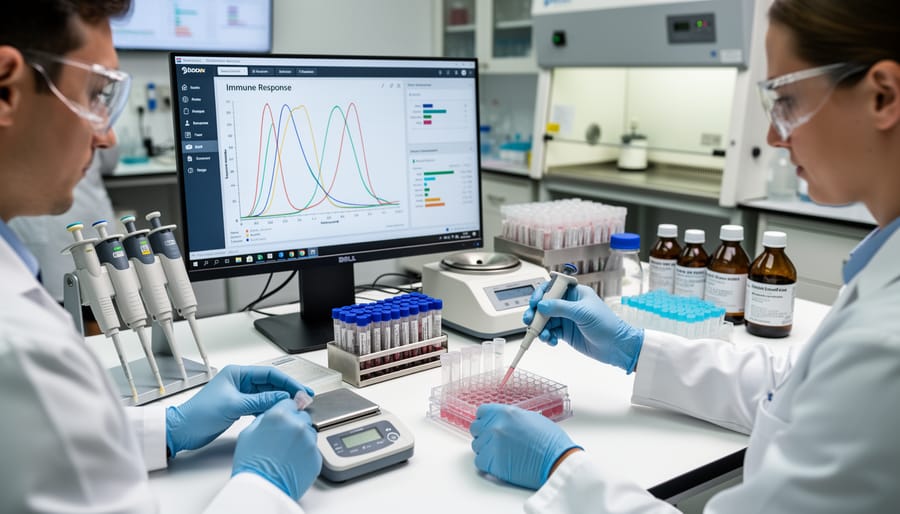
From a Question to a Measurable Result
Every study starts with a question, and often it’s a simple one. Say a researcher notices that certain immune cells seem to ignore a particular peptide signal. Why? That curiosity is the spark.
Next comes narrowing it down. A big question like “why do these cells stay quiet?” gets turned into something testable, such as “do these cells respond if we raise the amount of the peptide?” That small shift matters, because a testable question can actually be answered.
Then the researcher picks a model that fits, perhaps immune cells grown in a dish. A peptide is added to some cells, while other cells get nothing so there’s a fair comparison. After that, the watching begins. Do the cells release messenger molecules? Do they multiply? Do they change shape or switch on certain genes?
Finally, those observations become numbers and patterns. Researchers repeat the experiment several times to be sure the result wasn’t a fluke. If the same pattern shows up again and again, the original curiosity turns into a small, solid piece of understanding.
Why Controlled Settings Make Careful Study Possible
Controlled settings are what turn a hunch into trustworthy knowledge. In the body, hundreds of things happen at once. Hormones shift, infections come and go, and every person’s immune system has its own quirks. In a laboratory model, researchers can quiet that noise and change just one thing at a time, such as the type of peptide, the amount added, or how long cells are exposed to it. If the cells respond differently, they can be fairly confident that the change they made is the reason.
Repetition matters just as much. A single exciting result might be a fluke, so researchers run the same experiment many times, often in separate batches and sometimes in different laboratories. They also set up comparison groups, such as cells that receive the peptide and cells that don’t, to see what difference the signal truly makes.
When results hold up again and again, scientists and the wider community can rely on them. That steady, patient checking is slow, but it is why a finding can eventually guide real decisions about care.
The Main Kinds of Laboratory Models Researchers Use
Cells Grown in Dishes

Some of the clearest insights come from immune cells studied outside the body. Researchers grow these cells in small dishes filled with a nutrient-rich liquid that keeps them alive. Some come from donors who volunteer a blood sample. Others come from cell lines, which are cells that can keep dividing in the lab for years, so scientists can run the same experiment again and again with a steady supply.
Because the cells sit in a simple setting, researchers can add one peptide and watch what happens. Does a cell activate? Does it pass a message to its neighbour? This shows how cells signal each other directly, though it can’t capture the whole body.
Tissue-Like and Whole-Organism Models
Cells in a dish are useful, but they leave out the neighbourhood. In the body, immune cells move through tissue, bump into other cell types, and respond to signals in layers. Tissue-like models try to bring some of that context back.
Organoids are tiny, lab-grown clusters of cells that organize themselves into a miniature version of an organ, such as part of the gut or lymph tissue. Researchers can add a peptide and watch how different cell types respond together, which a single dish of cells can’t show.
Animal models, most often mice, go one step further. They let scientists see how peptide signals travel through a whole, living immune system. Because this involves living creatures, it is closely regulated. Research teams must justify their work and have it reviewed by ethics committees, with the aim of using animals only when no alternative will answer the question.
Computer Models and Simulations
Computer models work like a rehearsal before the real performance. Researchers feed information about a peptide’s shape and chemical makeup into software, which then predicts whether immune cells are likely to recognize it. Instead of testing thousands of possibilities one by one, scientists can use these predictions to pick a smaller list of promising candidates.
This saves time, effort, and resources. It’s also worth remembering that a prediction is only an educated guess. Researchers still confirm the most interesting results in cells, tissues, or other laboratory models before drawing any conclusions.
How This Research Is Used: From Lab Bench to Real-Life Impact
When a family is waiting for answers, it helps to know where laboratory work actually goes. Peptide-signal research doesn’t stay on the bench. It feeds into several practical areas:
- Understanding how immune disorders disrupt the messages passed between immune cells.
- Guiding vaccine development by showing which peptides prompt a strong, protective response.
- Testing potential treatments in models before they are ever considered for people.
- Developing diagnostic tests that can spot communication problems sooner.
Picture a composite example, not one real person’s story. A family has spent years going from appointment to appointment, hearing “we’re not sure yet” about their child’s frequent infections. Somewhere, researchers are working with immune cells in dishes and tissue models, watching which peptide messages go unanswered. That patient work may not name their child’s condition tomorrow, but it builds the map that future diagnoses and treatments are drawn from.
The same knowledge shapes how existing approaches are studied and refined. Researchers working on bone marrow transplantation and gene therapy for example, rely on a clear picture of how immune cells communicate, so they can judge whether a new approach is restoring those conversations.
It’s important to be honest about the pace. Progress is gradual, and a promising result in a dish or an animal model doesn’t always carry over to people. Bodies are more complicated than any model. That’s exactly why researchers combine several types of models and test carefully, step by step, before anything reaches a clinic.
For families, the encouraging part is that each careful finding narrows the path. Even a result that doesn’t pan out teaches researchers something, and that slow, steady learning is what eventually turns questions into answers.

Why the Patient Community Matters to Laboratory Research
Behind every laboratory model is a question that started with a real person. Patients, families, and advocates help shape what researchers ask and why it matters. Their role isn’t a side note to the science. It’s part of how the science moves forward.
There are many ways to take part. Some people join patient registries, which help researchers understand how often certain conditions appear and what everyday life looks like with them. Others volunteer for clinical studies when they feel ready, or simply share their lived experience so that scientists hear what symptoms, delays, and worries actually feel like. Even raising awareness among friends, neighbours, and local leaders helps, because understanding builds support for the work. Speaking up for research funding matters too, since careful laboratory studies take time, resources, and steady commitment.
You don’t need a science background to contribute. Staying informed helps, and reading about studies such as JAIDS research can give you a clearer picture of how immune system questions are explored and shared. Communities like Immunodeficiency Canada Network also help connect people to research updates, so you don’t have to search for answers alone.
When patients and scientists work side by side, the questions get sharper and the hope gets more grounded. You are a partner in discovery, and your voice counts.
Common Questions About Peptide Signal Research
Here are plain answers to the questions families and patients ask most often about this kind of research.
Is laboratory research safe for patients?
Laboratory models are designed so that experiments happen in dishes, tissue samples, or computer simulations first, which means people are not exposed to untested ideas. Studies that do involve people go through ethical review and carry their own safety protections.
How long before lab findings become treatments?
It usually takes many years, and many promising findings never reach patients. Each step, from the lab to careful testing in people, exists to make sure a treatment is both safe and genuinely helpful.
Are animal models always necessary?
Not always. Researchers often start with cells and computer models, and they turn to animal models only when they need to see how a whole body responds, under ethical oversight.
Can I take part in research, and will it apply to my condition?
Many people can contribute through patient registries or by joining studies, though eligibility depends on the study. Whether a finding applies to your specific condition varies, so ask your healthcare team what it could mean for you.
None of these answers replace personal medical guidance. Your immunologist or care team knows your history and can tell you which studies are worth watching, what a new finding might mean for your situation, and how to join research safely. Bringing a short list of questions to your next appointment is a good way to start that conversation.
When researchers study the immune system’s peptide messages in the lab, they are really learning how the body’s cells talk to one another. Cells in dishes, tissue-like models, careful animal studies, and computer simulations each add one piece to the picture. No single model tells the whole story, but together they help scientists understand where communication breaks down and what might help repair it.
That patient, step-by-step work is slow, and we know waiting is hard. Still, every question answered in the lab brings clearer explanations and better-informed care within reach. For families living with immunodeficiency, that is real reason for hope.
You are not alone in this. Stay connected with the community, share what you’ve learned, and keep asking questions. And if something here raises a question about your own health or your child’s, bring it to your healthcare team. They can help you understand what research means for you.